
If you run a business that depends on local customers, Local SEO (Search Engine Optimization) is the most powerful way to increase your visibility online. Whether you own a restaurant, a retail store, a clinic, or a service-based company, appearing in local search results can mean the difference between being found by new customers—or being invisible.
In this guide, you’ll find a complete Local SEO Checklist for 2025. It covers every essential step, from technical foundations to reviews, local content, and link building. Follow it step by step, and you’ll build stronger local rankings, attract more customers, and grow your business.
General Foundations in Local SEO Checklist
Before diving into advanced tactics, make sure your website is built on a strong SEO foundation. Google prioritizes user experience, so fixing technical and on-page basics can give you a competitive advantage in local rankings.
Make Sure Your Website is Mobile-Friendly
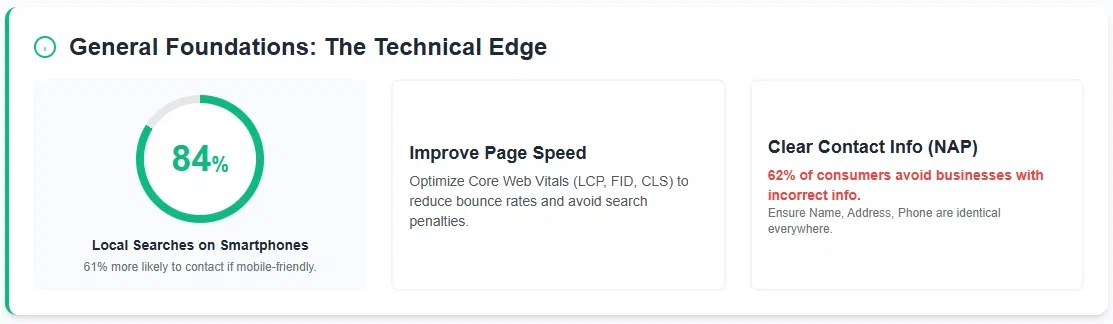
Because 84% of local searches are conducted on smartphones (Sagapixel), a mobile-responsive design is no longer optional. Moreover, 61% of mobile searchers say they are more likely to contact a local business if the site is mobile-friendly. If your site fails on mobile, you’ll lose both search visibility and conversions.
Improve Page Speed & Core Web Vitals
Site speed matters dramatically. Slow-loading pages deter users and are penalized by search engines. Given Google’s continued emphasis on user experience, Core Web Vitals (LCP, FID, CLS) must be part of your optimization. Faster pages help reduce bounce rates and improve engagement, which positively impacts local rankings.
Add Clear Contact Information (NAP consistency)
Local SEO relies heavily on consistency. In fact, 62% of consumers say they would avoid a business if they found incorrect information online (BrightLocal). Even minor differences (for example, “Rd.” vs “Road”, or alternate phone formats) can hurt your credibility in Google’s eyes. Make sure your NAP (Name, Address, Phone) is identical everywhere — on your site, your Google Business Profile, directory listings, and third-party platforms.
Google Business Profile (GBP) Optimization
Your Google Business Profile is often the first impression potential customers get. An optimized GBP can help you appear in the Local Pack, Google Maps, and local search results.
Claim and Verify Your Google Business Profile
Without claiming and verifying your GBP, your business may never show up in map-based results or the Local Pack. Verification (by postcard, phone, or email) ensures Google trusts your listing.
Add Accurate Business Information (Name, Address, Phone)
Several studies suggest that customers are 2.7× more likely to consider a business reputable if they find a complete business profile on Google Search & Maps (Ahrefs). Also, complete profiles (with accurate address, hours, services) are more likely to get clicks and visits.
Choose the Right Business Categories
Categories help Google understand what you do. Be strategic and choose your primary and secondary categories wisely — don’t stuff keywords, but cover your core services.
Add Photos and Videos of Your Business
Listings with photos receive higher engagement. Since many consumers make decisions based on what they see, high-quality visuals are essential to build trust and encourage action.
Post Updates and Offers Regularly
Active GBP profiles tend to perform better. Posting fresh content (offers, events, news) signals to Google that your business is alive and responsive, which can improve your visibility in local searches.
Local Citations and Directories
And ofcouse we don’t forget in local SEO checklist citations! Citations are online mentions of your business information (name, address, phone). They help search engines confirm your business’s credibility and improve visibility in local results.
Submit to Major Directories (Yelp, Bing, Apple Maps)
Major directories like Yelp, Bing Places, Apple Maps, Facebook, and Yellow Pages offer high domain authority and visibility. They also serve as sources of signals that Google may use to validate your business. In fact, 42% of local searches involve clicks on the Google Map Pack, so appearing in directories that feed into map data is crucial.
Check for NAP Consistency Across All Listings
As mentioned earlier, 62% of consumers would avoid a business if they find incorrect info online. To maintain trust and SEO strength, use tools like Moz Local, BrightLocal, Whitespark, or Yext to audit all your listings and correct discrepancies.
Use Local Niche Directories (industry-specific)
Examples: a dentist should appear in dental directories, a restaurant in food review sites, a real estate agent in property platforms. Niche listings often carry more weight in your vertical and attract more qualified traffic. They also help you build context — which is beneficial for topic authority in your field.
On-Page SEO for Local Search
Optimizing your webpages ensures that both users and search engines clearly understand your local relevance.
Optimize Title Tags and Meta Descriptions with Local Keywords
Include the city, neighborhood, or region in your title tags and meta descriptions (e.g. “Best Coffee Shop in Seattle, WA”). Pages optimized in this way tend to rank better for local queries. Given that 46% of all Google searches have local intent, this is a strategic must.
Use Localized Content (mention city, neighborhood, region)
Integrate local context naturally into your content — landmarks, neighborhoods, local events, common local problems. This helps Google associate your content with your area and improves user relevance.
Create Location-Specific Landing Pages (if multiple locations)
If your business has multiple branches, each location deserves its own landing page. Provide unique content, LOCAL testimonials, NAP, offerings, maps, driving directions, and distinct images. Avoid duplicating content across locations, because duplicate content can undermine SEO.
Add Schema Markup for Local Business
Use LocalBusiness schema (or specific subtypes, e.g. Restaurant, MedicalBusiness) to mark up your address, phone, opening hours, service area, reviews, and more. Structured data helps search engines understand your business better and can enable rich results or enhanced map displays.
Reviews and Reputation Management
Reviews are among the most influential signals in local SEO and consumer behavior.
Encourage Customers to Leave Google Reviews
Because 63.6% of consumers check Google reviews before visiting a business, consistently collecting reviews is vital. Ask customers at the time of service, via email follow-ups, SMS, or receipts. Provide direct links to your review page.
Respond to Reviews (both positive and negative)
Metrics show 88% of consumers would use a business that replies to all of its reviews. Engaging with reviews shows you care, builds trust, and can mitigate the impact of negative feedback. Always be polite, constructive, and thoughtful in your responses.
Monitor Reputation on Third-Party Sites (Yelp, TripAdvisor)
Don’t limit yourself to Google. Many customers use Yelp, Facebook, TripAdvisor, industry-specific platforms to evaluate a business. In 2024, 81% of consumers used Google to research local businesses, followed by Yelp with 44% usage. Make sure to monitor and respond on all major platforms to maintain a positive reputation.
Content Marketing in Local SEO Checklist
Content tailored to your local audience helps establish authority, attract nearby customers, and improve visibility in local search.
Create Blog Posts About Local Topics and Events
Writing about things like “Top festivals in [City] this year,” “How winter affects plumbing in [Region],” or “Best family-friendly parks in [Neighborhood]” draws locals in. These topics tend to have lower competition and higher engagement.
Collaborate with Local Influencers and Partners
Working with local influencers, bloggers, chambers of commerce, or community organizations can amplify your reach and lead to high-authority local backlinks. This not only helps SEO but also drives brand exposure in your area.
Publish Case Studies or Success Stories of Local Clients
Show real results for local clients to build trust and relatability. Prospective customers seeing a story about a neighbor or nearby business are more likely to believe you can deliver for them.
Link Building for Local SEO
Local backlinks are powerful signals showing that your business is relevant to your community and industry.
Partner with Local Businesses for Backlinks
Form alliances with complementary local businesses (e.g., a café linking to a local bakery, or a gym linking to a health supplement store). These links are contextually relevant and often easier to earn.
Get Featured in Local News or Blogs
Pitch local journalists or community bloggers with press releases, business milestones, or educational content. Being featured in trusted local publications gives you both visibility and authoritative backlinks.
Sponsor Local Events or Organizations
Sponsoring community events, sports teams, charities, schools, or meetups often comes with mentions and backlinks from event sites or partner pages. This not only improves SEO but also fosters goodwill and brand recognition locally.
Tracking & Monitoring
You need analytics to measure success, diagnose weaknesses, and iterate your strategy over time — and this Local SEO checklist helps you stay on track.
Use Google Analytics 4 for Local Traffic Insights
GA4 provides metrics like geographic location, user journeys, and conversions. Monitor how much traffic comes from your target area and which pages attract local users. Use this to refine your content and SEO efforts.
Track Keyword Rankings for Local Search Terms
Monitor how you rank for local-intent keywords (“near me,” “in [city],” etc.) using tools like Ahrefs, Semrush, or BrightLocal. Since 42% of local searches involve clicks on the map pack, tracking your presence there is critical.
Monitor Google Business Profile Insights (calls, clicks, views)
GBP shows how many people clicked your website, asked for directions, called you, or viewed photos. These metrics help you understand user behavior and optimize your listing. For instance, 76% of local searches on a smartphone lead to a visit within a day — tracking direction requests can help you correlate visibility with foot traffic.
Conclusion
Local SEO isn’t a one-time fix — it’s an ongoing process. The data makes it clear:
- 76% of smartphone users conducting local queries visit a business within one day (Think with Google).
- Approximately 46% of all Google searches have local intent (Hennessey Digital).
- 63.6% of consumers check Google reviews before visiting a business (Ahrefs).
- 42% of local searches lead to clicks in the Google Map Pack.
By following this checklist, you’ll strengthen your online presence, improve your rankings in Google Maps and local search results, and attract more customers to your business.
Need professional help with Local SEO? Contact me today and let’s grow your local visibility together.